Monday, February 10, 2014

Cachupa

I love cachupa; a hominy based stew with chicken, beans, sausages and other meats in a tomato and vegetable base. This is an Angolan dish that has many variations and everyone has their own way of making.  Some use greens as well while others go for just the hominy, chicken and one type of sausage.   The humbler ones, I think, are uncomplicated and better.


Not far from us, there is a very simple restaurant where I have eaten lunch several times with my husband since it is not far from his office either. This diner serves business men and other local workers and they usually have a variation of cachupa and it is always good. You serve yourself from the entreés, beans, rice and other sides and weigh your plate at the register. As I was taking the below picture of the entrance, a very stern-looking woman who emerged from the side of the building asked me brusquely if there was a problem. "No probem", I said and I was about to tell her how much I like the food here when she angrily replies "If there is a problem, I should know then!" There is really some kind of paranoia about picture taking in this country which I have yet to figure out.
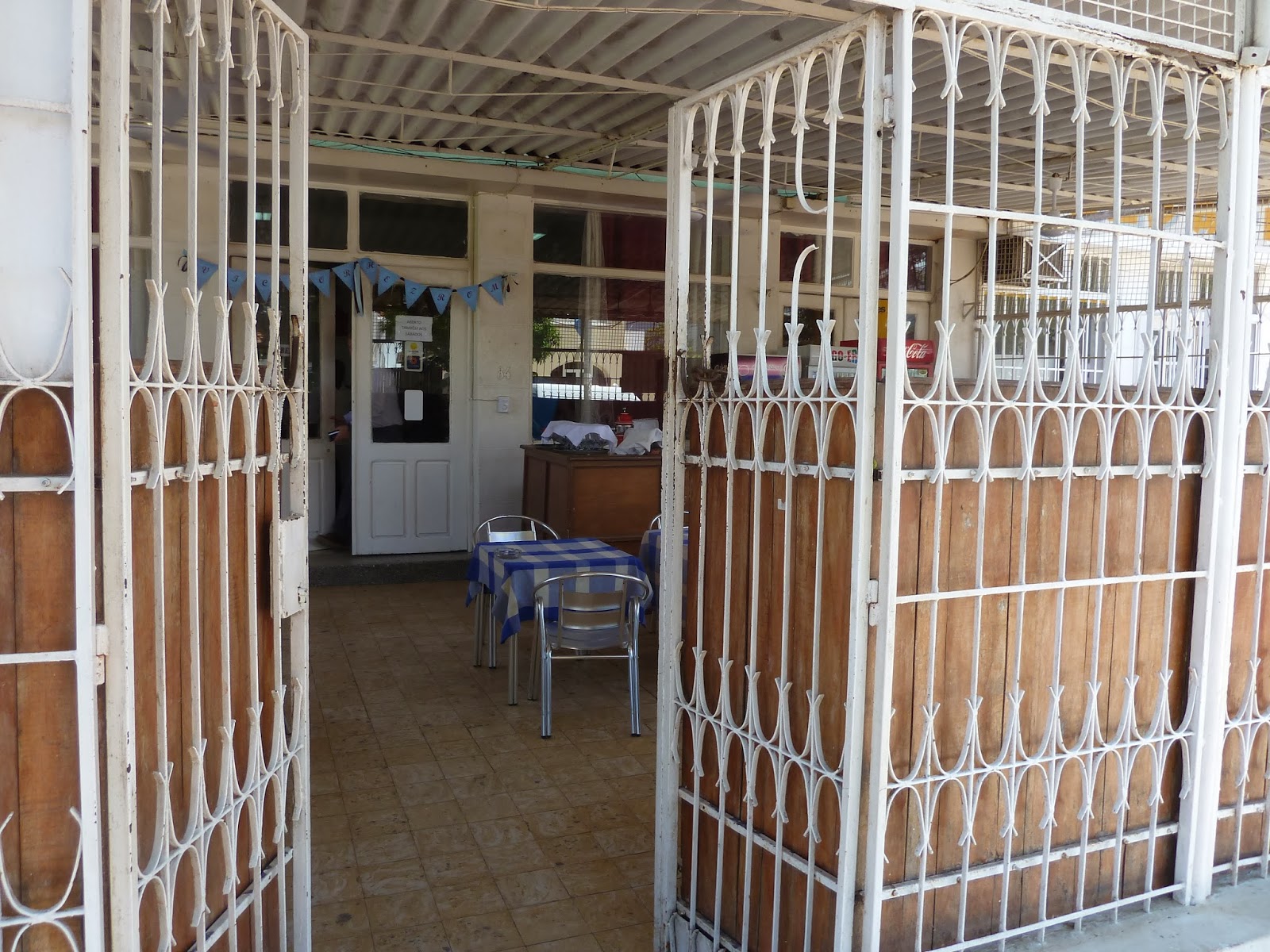


Another place I like is not far either. I must admit that my husband was the brave one here since he ventured in with a colleauge. The entrance  does not look promising and the set up is simple: plastic tables and chairs, a tent shade, unmatched cutlery, but my, is the food good! With a side of rice and a cold Cuca beer, you can't go wrong with their cachupa!


I want to learn how to make it myself and take my maid, Maria,  to a giant grocery store to help me pick what we need. As you can see, the selection of sausages is huge. I am willing to try even the blood sausages, but I can not stomach the cow intestines. No matter, Maria says, it will still be good! As we shop, she tells me tha in the old days, this was usually served during wakes and some of the senior population still associates this dish with death.


The selection is astounding

We start our with a big pot and boil the hominy. This takes a couple of hours to soften at a simmer. In another pot, the meat (pork, chicken and beef) cook together with onion and tomatoes  and the greens, which remind of spinach, but are called "cove" are sweated out separately. The sausages are cut and added in at the end.

Our cachupa ingredients

Here you see three types of sausage pork, chicken, beef, beans, canned tomatoes, fresh tomatoes, green bell peppers and greens. It is a one pot meal, easy and delicious. I must say I prefer without the greens since they do add a bit of bitterness. Some of the sausages are too fatty for my taste, but they do give a delicious flavor. We end up with an enormous amount since the kids thought the hominy was weird and I end up freezing half of it. Good to know I have an easy dinner ready for a day I don't feel like cooking!

Monday, January 27, 2014

Flat tire

When the car gets back from delivering the kids at school, it has a flat. Now, I have never shied away from changing a tire; I at least go through the motions of taking out the jack before help arrives, but I have never actually completed this myself and I rely on my driver to help me out.

I take the manual out, and we begin, but it is soon apparent that the team of "Twiddle Dum and Twiddle Dee" is not going to be very efficient. Thankfully, a couple of other drivers hanging out in the basement are attracted by our fumbling and they start coming with their advice. The tire is changed, and I realize, that it is not as scary as it seems.

Now, we have to repair the tire. The other drivers and the maintenance man recommend a vulcanization shop not far and they tell me it will cost 1,000 KWZ (10.00 USD)

My driver and I head just a couple of blocks away to a sidewalk repair shop. I see men in overalls, a bathtub and hoses. We approach them and they look at the tire and say, no problem. However, the price is 1,500 KWZ per plug. All right, so a 50% increase in price because I am a foreigner is expected. I try to negotiate, but they stick to their guns and since I am close to home and realize that any other workshop will entail battling traffic, I accept.

Things get rolling quickly and I am showed the plug. Not sure what I am looking at, but I have to have a car, with a spare, this afternoon to pick up the kids and they assure me that it will be done correctly. I can't call anyone since my phone has no service for some reason.


First, they find the cause: a metal piece that was almost completely impaled into the tire.

The culprit

Then, they take a plug, fold it in half and stick it into the hole. This is repeated since the opening is so big. The price is now doubled since they use another plug.

Then, they check whether the plug has done the job by sticking the tire into the bathtub. As they roll it around, another puncture on the side is discovered as water shoots out and barely misses me.  Another plug is needed, although they maintain that they used  a 4th. 


The patched tire is bounced on the sidewalk to show me that it is indeed holding the air. By now I am laughing as are the spectators gathered to watch the work. The repaired tire is safely put in place and I go to pay. I am suddenly being charged labor as well and after some discussion they get 6,000 KWZ ($60) and not the 7,000 KWZ they ask for. As I pay, ice cold Heinekens are cracked open. Yes, it's very hot and yes, I over-paid.  

Later in the afternoon, one of the professional drivers where my husband works is finally contacted and when I show him the metal piece, he has no doubt that we need a new tire since the plugs will not hold.     

Tuesday, January 7, 2014

Expensive Shade

We headed out to Mussulo, a 35 km. long sand spit which runs parallel along the southern part of Luanda. This is a popular spot on the weekend where many flock to escape the city.

The first challenge can be parking.  On the 2nd of January, many New Years revelers were probably at home resting which meant we found a spot right away. This is usually a major headache as parking is scarce and cars may be stopped at the main highway turn off leading down to the parking area and have to wait for spots to open up.

The second challenge is getting a boat. Simple, outboard boats ferry people back and forth across the bay. Locals will run up and immediatly begin haggling as they all want customers. The discussion can get quite heated, but we had already commited ourselves to the man that had "helped" us park. As soon as this was made clear, things quieted down and we proceeded on to the boat. We all got life jackets although some of them were ill-fitting. The ride was surprisingly fast and the water was a beautiful turquoise-green. Mussulo sparkled ahead.

 We had not known what to expect, so we took along beach chairs and drinks. Apparently the fact that we brought our own cooler limited us to where we could actually go since some of the restuarants do not allow coolers on their premises,  so we trusted the captain.

We were let off at restaurant/hotel/ facing the bay which had "tiki" huts and two lounge chairs each.  There were several empty huts, but at first told that they were "reserved". After further questioning, the waiter decided that we could, after all, set up camp under one. After a while, the waiter came to collect for the use of the hut and cheerfully informed us that we owed $40.00! Not only that, but the restaurant was only serving a buffet lunch and that the pricer per head was $75.00!!! We were certainly glad that we had had a late breakfast and had packed some pretzels and some mixed nuts. We think that the price was slightly higher than normal due to it being holidays , but even so...


Granted, the huts were beautifully made and structurally sound, but their shade was nothing less than what you would expect from any shade: shade. The surroundings were nice, but nothing that warranted such an extravagant price. The showers were non-functional, but the fee also allowed us to use the bathroom which was pretty nice: toilet paper, soap, towels and functioning toilets. Again, just what you would normally expect from a bathroom.

Luanda is one of the most expensive cities in the world, but I continue to be shocked. Next time, we will also pack food and our shade tent and be left off on the Atlantic side where there are no facilities and enjoy ourselves just as much at a fraction of the cost!

Sunday, January 5, 2014

Back on the Board

One of the reasons my family was looking forward to coming to Angola was the promise of good surfing.  Surfer's Beach is approximately 1 1/2 hours drive south of  Luanda, depending on traffic. The turn off is just south of Cabo Ledo, entering through what is a gravel producing area, "Pedreria," requiring a 4-wheel drive vehicle.

Our first visit back in September was a bit disappointing for this warm-blooded girl. The beach was sandy and beautiful, but there was no way I would go in the water even with a body suit. Even my son, who is half viking, could not remain in the icy water too long. Sadly, my board remained on the beach.

In the end of November everything was different. The beach was not as wide and the waves were entering the bay at a different angle, the water was warm enough for me and  was beautifully clear. The waves were perfect for a beginner as myself and other more experienced surfers were also enjoying themselves further out. The waves came in at a 45 degree angle, which was quite a change from their  almost parallel entry on to the beach, back in September. A new surfing acquaintance, who has surfed all over the world, told me that he was able to ride the longest wave of his life along the beach and had to walk back for 30 minutes to his original starting point back then! Definitely less tiring to surf this way when one does not have to paddle out so much to catch the waves.

Even though paddling out was necessary this time around, I prefer the warmer water any day! I used my new, much shorter, soft board and stood for seconds which was good enough for me on my first real try under new conditions.

We were prepared to bring everything needed: plenty of water and food. The only amenities are simple shacks that provide a narrow strip of shade  for which we paid $USD 5.00. Even so, it was smart to bring along a shade tent and plenty of high factor sunscreen. Some surfers camp out overnight and locals sell fish and lobsters which they grill on the fires they make on the beach.

On our third visit yesterday, the beach had once again gone through a transformation: less beach and much more shallow water. It was quite windy and actually almost chilly under the shade. The water was clear and beautiful and full of jumping fish. Not many surfers this time, but definitely still possible to surf. The water is a gorgeous turquoise/green color and the beach is clean.

All in all feel much more positive about the beach now that I know I can surf for at least part of the year. I think we will be coming here much more often on the weekends. Back on the board feels good!


Friday, November 15, 2013

Kissama National Park

Kissama Natioanl Park lies approximately 75 km. south of Luanda, the capital. The park was established in 1957 and was once teeming with wildlife throughout its 2.5 million acres or 1 million hectares (!). However the civil war that wracked the country for over 20 years took its toll. The population of elephants, rhinoceroses and buffalo was almost completely extinguished due to poaching and over-use of the vegetation.

Imbondeiro trees are starting to sprout


Efforts by the Kissama National Park Association to re-establish the animal population has taken place in the form of the project "Operation Noah's Ark" in which primarily elephants from neighboring Botswana, Namibia and South Africa were either airlifted or shipped to Kissama.

We headed to the park last weekend with friends and stayed in some small cabins inside the park which were just fine. It was a holiday weekend and there were many people there. We had originally scheduled a safari for the afternoon after we arrived, but they were over-booked, so we settled for a nice boat ride on the Kwanza river which was bordered by grasslands and beautiful hyacinths. We saw a small, baby crocodile, but no manatees. I spoke to one of the guards and he said that they had started to see younger generations of animals and that they were pleased that the different animal populations were growing.

I can live anywhere that has palm trees!
The next morning we woke up very early and already there were many people out and about. The manager assured me that there was room for our party of 11 since there would be using two vehicles. However, one of the vehicles would not start and it was a mad dash into the trucks. We got room, but the rangers were trying to get another family of five on by having us place the kids on our laps. We refused because of safety and eventually we headed out. At first we did not think that we would see any animals, but after about 45 minutes we met some giraffes eating their breakfast. They were rather close to the road and did not seem to be too bothered by us. After that, we began sighting antelope, bush bucks, elands and some pretty amazing birds.

The vehicles were open and we bounced around and I was slapped and whipped a bit by the overhanging branches since I sat on the side, but it was still really enjoyable. The temperature was perfect, but climbing steadily with the sun. My little camera is just not good enough for the shots I want to take!

As we headed to the river, we heard some trumpeting! Could it be? Yes, a single, young male elephant with small tusks, trumpeting at us through the trees. He was flapping his ears and making lots of noise, being a real show off! He was trying to scare us, but he never got too close. He followed us through the   trees and underbrush marking his territory as we observed each other for a good while. After all pictures were taken and everyone had had a good look, we headed to the river. Although my family has seen many elephants in Sri Lanka, for some reason, this encounter seemed more "real" and maybe it was the proximity as well as his behavior that made it thrilling.  Down by the river we saw water buffalo and wildebeests and as we returned many more antelope, bush bucks and elands.


There are supposed to be some ostriches and zebras in the park, but in small numbers and we never sighted them. A count conducted in 2008 found 15 ostriches, 55 elephants and 45 zebras. Given the sheer size of the park, we were lucky to see the animals we saw!

For a small taste of what it looks like, please see: http://www.youtube.com/watch?v=v4Xc_psxi9U
For more information; http://www.wild.org/where-we-work/quicama-kissama-national-park-angola/

Friday, November 8, 2013

Street Manicure

Sprinkled throughout the down town area, sit young men with their manicure stalls. Two simple chairs, a fold-up table, a poster with a sampling of effects and an assortment of varnishes make their manicure stations. Some don't have chairs and the manicurist and customer find a convenient sidewalk or steps to sit on. Otherwise, they walk the streets with their stalls balanced on their heads and carrying their stools hoping to bump into customers. It seems like a pleasant encounter and I have caught snatches of conversation about the boyfriend, plans for the evening or the selection of color as I walk by.


I finally get up the nerve to get one at one of the nearby corners. This particular manicurist sits next to a woman selling fruit and usually one or two other young men are hanging out on the steps playing Chinese checkers.

I approach the stall and the manicurist is happy to paint any of the designs he advertises. I don't want anything too flashy and we settle on one of the more discrete colors and designs.

He files my nails, applies cuticle remover and gently removes the superficial skin. I tell him I don't want him to cut using scissors, but he does not use them normally he says.

I ask him why it is that it is men working as manicurists, but he says that there are women as well although I have never seen any. He says that he began out of curiosity. He observed another manicurist and was fascinated by the designs and started for himself. I wondered if he had sisters and if he practiced with them, but no, he is an only child. The number of customers he has a day varies quite a bit, but usually Fridays and Saturdays are his best days. I ask him why he works on the street, whether he would rather work in a salon and he says he wants to be independent and not have to pay the salon any fees. He is pleasant and quiet and life on the street continues as normal. People walk by and hardly glance our way, this is just an every day sight for them I imagine.

BEFORE                 
AFTER
(notice the tiny little hearts)

At 500 Kwanzaas or $5.00 USD this is a bargain. I payed 5 x as much at a "salon" and after two days the varnish peeled of completely. We'll see how much this one lasts...

The fruit lady wants me to buy fruit, but I have already done my shopping I tell her. I offer her a manicure if she lets me take a picture. She gets her toes done!


Monday, November 4, 2013

Medical Evacuation

The words medical evacuation strike a bit of fear in all expats, I am sure. Our experience was not critical and not an emergency, but it was definitely a medical condition that needed to be attended to.

It does sounds much more serious than it was, but I found myself back in South Africa for a medical appointment with one of my kids. About a week after our return from fantastic Cape Town, I was back on a plane to Johannesburg. The medical follow-up we had received in Luanda was not well-coordinated among some specialists and the treatment my child received is questionable. However, we met with a Dr. at Milpark Hospital in Johannesburg and I was impressed with both his expertise and the overall service of everyone we met. The friendliness of South Africans is so refreshing and it was a pleasure to be there even under the circumstances. Fortunately, nothing serious was found, but more antibiotics were recommended. We will return if this does not solve the problem.

We stayed at two Bed & Breakfasts in a very pleasant neighborhood, Melville, full of gorgeous trees. The jacaranda trees were in full bloom and their lavender flowers adorned the city. Several streets had jacaranda trees on both sides and it was like driving under a lavender arch. We walked to nearby restaurants and never did I feel threatened although so much is said about crime in Johannesburg. We did take precautions like not take out money from the ATM at the airport and arranged for an airport pick up ahead of time. Also, we only used taxis known by the B&B's. There are neighborhoods and areas where one should be very careful and never venture in at night, but we had no need to go there. Most houses have high walls and almost all of them have stickers or signs advertising the security company that will respond with armed personnel.

The only experience which was a bit scary was using a taxi minivan when we were stuck at a shopping mall and had to return to the hospital. There were no taxis except for these crazy minivans and after some haggling, we ended up in a minivan full of women that had been waiting to leave and were not at all happy when they were told that we would be dropped off first at the hospital. The driver said "My sisters, I am sorry, but ... (switched over to another language) and the response was negative to say the least! We got off when we saw things were heating up between the ladies and the driver and then when the driver realized we were leaving, he got another minivan to take us. This driver was honking at everyone, shouting out the window and driving like a maniac while periodically smiling at us in the rear-view mirror. I was just about to ask him to stop, when I saw the hospital. Whew!

In between appointments, it was shopping for clothes, books, kitchen stuff and even Christmas ornaments which had already started coming out! In our little neighborhood of Melville, I found a nice little boutique where I got two beautiful, classic cut dresses (Yay!). Our hostess did us the great favor of buying us a Coleman cooler which we filled with our clothes and books as a piece of luggage. Good coolers are an absolute necessity in Luanda if we go to the beach or take any kind of road trip and I have yet to find a good one.

The food in Johannesburg was really good and we could pick among all sorts of food. A really good glass of wine with dinner was $4.00 and we ate some of the best lamb roast I have ever tasted. Red velvet cake is served everywhere and we shared a piece with a baked cheesecake bottom with one of my brother's friends whom met us and took us around one day. The world can really be small sometimes.

At the airport in Luanda we noticed that we were not the only ones coming back with Coleman coolers. Apparently, many people stock up on meat from South Africa. At the luggage carousel  there were several other coolers on the conveyer belt and I was really hoping that everyone would take the right one home. At this point our clothes and books are much more treasured than meat! Good meat is easier to find and of good quality while books in English are not found anywhere and clothes worth buying are crazy expensive.

All in all, I would call this an excellent medical evacuation and hope to return under different circumstances!